
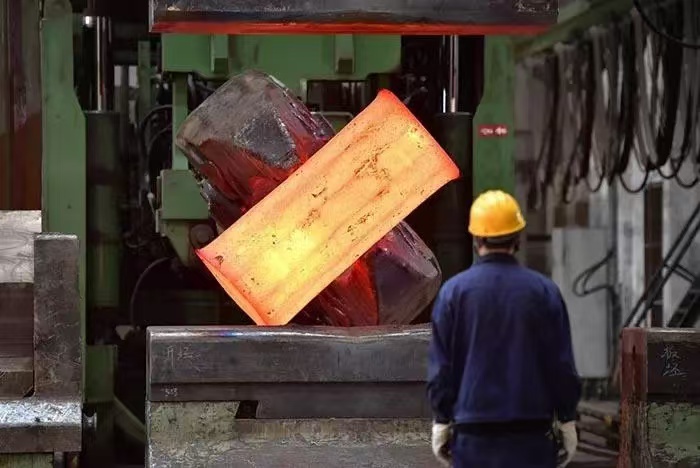
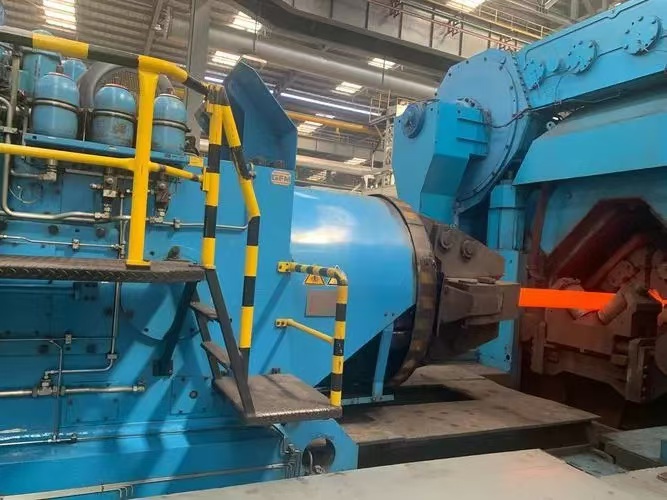
1. Definition of forging: Forging is a processing method that uses forging machinery to apply pressure to metal blanks to make them plastically deform to obtain forgings with certain mechanical properties, certain shapes and sizes. It is one of the two major components of forging (forging and stamping). Titanium and titanium alloys, like other metal materials, generally use forging technology to produce high-quality processed parts. The forging methods of titanium and titanium alloys are divided into: free forging, hot die forging and special forging.
2. Purpose of forging: Forging can eliminate defects such as loose casting produced by metal in the smelting process, optimize the microstructure, and at the same time, because the complete metal flow line is preserved, the mechanical properties of forgings are generally better than those of castings of the same material. Important parts with high loads and severe working conditions in related machinery, except for simpler shapes that can be rolled plates, profiles or welded parts, are mostly forged.
In my opinion: forging is like kneading dough when an old mother processes pasta. The purpose of kneading the dough is to mix the water added to the flour evenly with the flour, and to allow the protein and other nutrients dispersed in the flour to absorb water evenly and gradually condense to form gluten. Under the action of gluten, a network structure is formed, which can wrap the gas produced during fermentation and form a fluffy texture.

3. Free forging
Free forging (ODF) of titanium and titanium alloys: It is a forging method that uses external force to deform titanium and titanium alloys between upper and lower anvils to obtain forgings with certain microstructures, properties, shapes and sizes;
(1) Đặc trưng:
It can improve the internal structure of the alloy and improve the mechanical properties;
The process is flexible and the blank can flow freely from any direction, which is suitable for the production of large forgings; low cost and economical; the precision of the forged parts is not high, so it cannot be forged too complex;
(2) Free forging can be divided into:
· Manual free forging: that is, the blank is deformed by manpower using tools such as hammers and punches to obtain forgings. Its advantage is low investment, but low production efficiency, and it is only suitable for finishing or forging of uncomplicated small parts;
· Machine free forging: that is, the blank is deformed by the pressure or impact of the machine to obtain forgings. It has high production efficiency and is widely used by us. Common machine free forging equipment includes steam + air free forging hammer, hydraulic press, air hammer, vân vân., among which air hammer is the most widely used.
| Step | Sự miêu tả |
| 1. Material Preparation | Titanium ingots, after melting, are machined to remove surface defects and cut off the riser end. |
| 2. Heating | Heat the titanium alloy billet to a suitable temperature, generally within the β-phase zone (850°C–950°C). Proper heating ensures the material reaches a plastic deformation state. Based on production experience: for a 3-ton, φ640mm TC4 titanium ingot, it takes 5.5 hours to reach the target temperature. Heating Phases: – Heating up – Reaching temperature – Holding temperature – Removal from furnace (A detailed “Forging Temperature Record Sheet” includes the heating curve.) |
| 3. Forging | Place the heated titanium alloy billet on the forging press. Control the temperature and deformation ratio (30%-50%). Avoid flattening the material in one blow. Follow a three-stretch, three-upset forging sequence to eliminate casting defects, such as porosity. |
| 4. Cooling | After forging, allow the hot titanium alloy billet to cool in air to room temperature. This enhances strength and toughness. |
4. Hot die forging
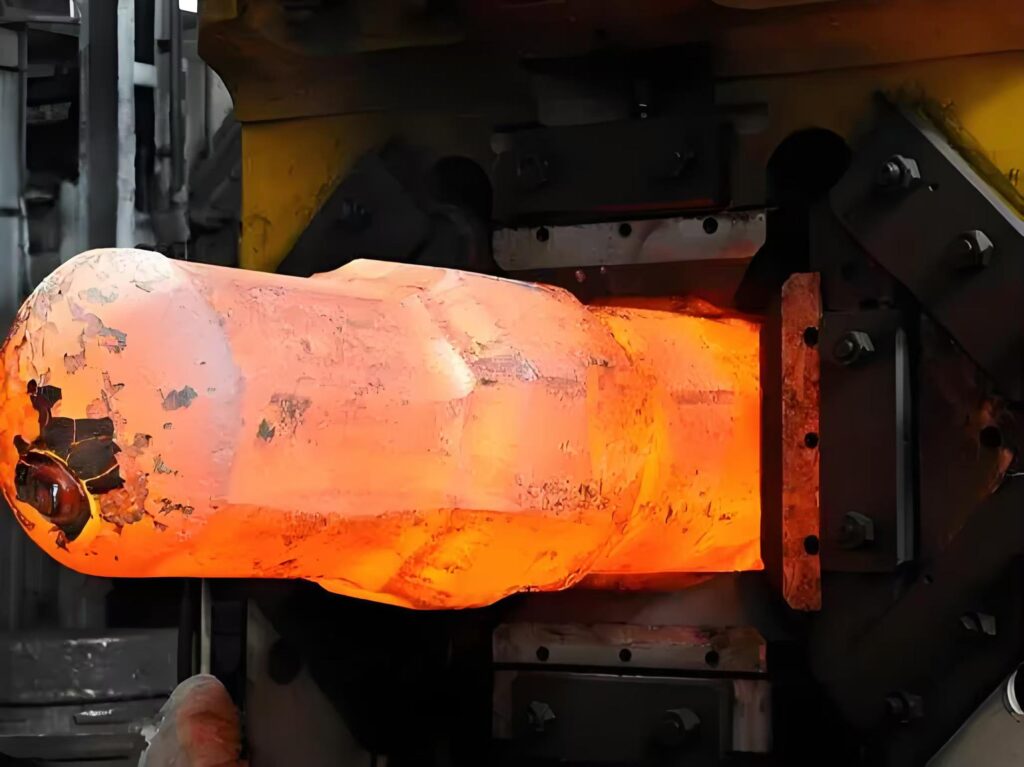
Hot die forging (HDF) of titanium and titanium alloys: It is a forging method that uses external force to deform titanium and titanium alloy billets in a die, thereby obtaining forgings with microstructure, hiệu suất, shape and high dimensional accuracy;
(1) Đặc trưng: Since the deformation occurs in the die and the stroke of the die is fixed, the forgings produced are of high precision; since the force is uniform in the die, the lines of the forgings are evenly distributed;
(2) Hot die forging can be divided into:
· Ordinary die forging (DF): It is a forging obtained by extruding the metal in the die with or without heating, using pressure or impact force;
· Isothermal die forging (IDF): It is a die forging performed at a low strain rate with the die heated to a temperature close to or equal to the deformation temperature of the billet.
·Superplastic forging (SPF): refers to a process in which a metal or alloy is forged under the conditions of low deformation rate, certain deformation temperature and uniform fine grains to obtain a processed part;
5. Special forging
Special forging (SF) of titanium and titanium alloys: is a forging method that uses external force to deform titanium and titanium alloys on special equipment to obtain forgings with microstructure, hiệu suất, shape and size;
(1) Đặc trưng: high production efficiency, suitable for mass production of titanium alloy forgings; high surface quality and precision of castings, good internal performance; saving metal materials;
Phần kết luận: Why Titanium Forging is Essential for High-Performance Applications
Tóm lại, the forging processes of titanium and titanium alloys—including free forging, hot die forging, and special forging—are critical for producing components with superior mechanical properties, precision, and durability. Whether through the flexibility of open die forging or the precision of hot die forging, these methods optimize the microstructure and eliminate defects that can arise during casting. This makes titanium forging ideal for industries like aerospace, medical equipment, ô tô, and industrial manufacturing, where high-performance, reliable parts are essential.
If you’re looking to explore high-quality titanium forging services or need customized titanium alloy parts for your project, contact us today to learn more about how we can meet your specific requirements.