
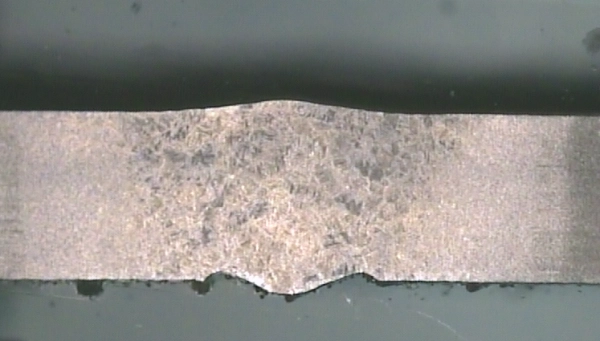
- Crevice corrosion
Titanium has particularly strong crevice corrosion resistance, and crevice corrosion only occurs in a few chemical media. Crevice corrosion of titanium is closely related to temperature, chloride concentration, pH value and crevice size. According to relevant information, crevice corrosion is likely to occur when the temperature of wet chlorine is above 85°C. For example, some factories use a packed tower to directly cool the wet chlorine gas before the cooler to lower the temperature to 65-70°C, and then enter the titanium cooler to improve the resistance to crevice corrosion. The effect is also very significant. Practice has proven that lowering the temperature is an effective method to prevent crevice corrosion. Generally speaking, the possibility of crevice corrosion in narrow gaps is much greater than that in wide gaps. At a certain wide gap, the crevice corrosion of titanium reaches an extreme value. When the gap is small, since the corrosive medium cannot wet the inner surface of the gap, even if it wets the inner surface, its flow is restricted and the titanium oxide film has not been destroyed; if the gap is large, the diffusion of oxygen is quite rapid, enough to Titanium passivated. Therefore, when the gap is small or large, it will not cause crevice corrosion.
- Stress corrosion
Except for a few individual media, industrial pure titanium has excellent stress corrosion resistance, and it is rare for titanium equipment to be damaged by stress corrosion. Industrial passivated titanium can only be used in fuming nitric acid, certain methanol solutions or certain hydrochloric acid solutions, high-temperature hypochlorite, molten salt with a temperature of 300 to 450 ℃ or NaCl-containing atmosphere, carbon disulfide, n-hexane and dry chlorine. Stress corrosion occurs.When concentrated nitric acid contains more than 6.0% NO2 and less than 0.7% H2O, industrial pure titanium will suffer from stress corrosion cracking even at room temperature. Serious stress corrosion and explosions have occurred in my country when titanium equipment was used in 98% concentrated nitric acid. Although titanium has stress corrosion cracking in some special media, compared with other metals, titanium’s resistance to stress corrosion cracking is still good. When stress corrosion occurs in titanium, as the surface becomes passivated, a large tensile stress will be generated, so that dislocations begin to move under low external stress. When the local plastic deformation promoted by corrosion develops to a critical state, the stress concentration at the front end of the dislocation accumulation group is equal to the atomic bonding force, leading to the nucleation of microcracks! After the crack is nucleated, the Fermi level of the tip matrix is higher than that of the rest of the crack. In this area, the electrode potential at the crack tip is low, and under the action of the corrosive medium, the metal at the crack tip undergoes anodic decomposition. On the one hand, hydrogen reduces the surface energy of the crack. Under the action of external force, the cross section will expand in order to balance with the external force. On the other hand, hydrogen increases the difference in Fermi level between the crack tip and other areas of the crack, increases the corrosion potential difference, and promotes the development of stress corrosion.
- Hydrogen embrittlement corrosion
Titanium is an active metal that reacts with hydrogen not only on the surface but also diffuses into the interior of titanium. When the hydrogen concentration in titanium reaches a level that can form an independent titanium hydride phase, titanium will embrittle. Hydrogen may exist in the metal before the titanium material is used, or it may be absorbed by the use in hydrogen gas or hydrogen-containing media. Therefore, during the actual use of titanium equipment, special attention should be paid to hydrogen embrittlement to avoid damage to the equipment.Generally speaking, hydrogen in titanium is divided into two types: internal hydrogen and external hydrogen. Internal hydrogen refers to the hydrogen introduced during titanium smelting, heat processing, heat treatment, pickling, electroplating, etc. Titanium originally does not contain hydrogen or contains very little hydrogen, but when used, it is called external hydrogen due to the introduction of hydrogen from the external environment. Hydrogen, specifically, generates active hydrogen atoms on the metal surface through the following ways, and then enters the metal. (1) The medium in which titanium equipment is located contains molecular hydrogen, such as a high-temperature hydrogen atmosphere. (2) The hydrogen generated by general corrosion or local corrosion of titanium is absorbed by titanium. For example, crevice corrosion of titanium is often accompanied by hydrogen absorption. (3) Hydrogen generated when titanium and electronegative metals undergo galvanic corrosion or cathodic protection. The latter two types of titanium hydrogen embrittlement caused by electrochemical corrosion of the cathode are more frequent and can occur without high temperature and high pressure, so they should be paid more attention to.Hydrogen embrittlement of titanium materials is affected by many factors. The main influencing factors are hydrogen content, strain rate, stress, stress concentration, medium temperature and environment, etc. When the titanium surface is contaminated by metallic iron, the hydrogen absorption capacity of titanium will increase. Because iron can form a corrosion microbattery with the titanium matrix, nascent hydrogen is generated during the corrosion reaction, which increases the active points and active channels for hydrogen to enter, making it easier for hydrogen to invade, and the damaged film is not easy to repair. The effect of temperature on titanium’s hydrogen absorption is mainly reflected in increasing the reaction rate between titanium and hydrogen and the diffusion rate of hydrogen in it. At low temperatures, the diffusion rate of hydrogen in titanium is very small. But at higher temperatures (greater than 80 ℃), hydrogen absorption will become obvious. Above 300 ℃, the reaction rate between titanium and hydrogen accelerates sharply, generating a large amount of hydride and causing obvious hydrogen embrittlement of titanium. When the temperature exceeds 316°C in a hydrogen atmosphere, titanium equipment is generally not recommended. According to the above influencing factors, methods such as reducing the hydrogen content in the titanium material, increasing the hydrogen solid solubility of the titanium material, reducing the surface pollution of the titanium material, reducing the iron content in the titanium material, and eliminating residual stress can be adopted to reduce hydrogen embrittlement corrosion. occurrence.
- Pitting corrosion
The occurrence of pitting corrosion depends on the degree of damage to the oxide film of the parts that can cause pitting corrosion. This kind of corrosion is easy to occur in areas with gaps. The passivation film on the surface of the titanium material cannot self-passivate after being partially destroyed, causing surface electrochemical inhomogeneity, causing corrosion to develop in depth in some parts, forming point-like localized corrosion. For example, when a titanium exchanger is used in a zinc chloride solution, pitting corrosion is likely to occur at the parts in contact with iron; in sodium chloride solution, titanium heat exchangers also have slight pitting corrosion; PTFE plastic gaskets are incompatible with titanium Parts that form gaps are the most likely places for pitting corrosion; titanium also corrodes slightly in calcium chloride and aluminum chloride solutions, but corrosion occurs within a certain concentration and temperature range. In addition, due to improper heat treatment , pitting corrosion often occurs in discolored parts during hot processing, molding and welding, and in contaminated parts such as iron. High temperature and medium concentration chloride solution is the main medium that causes pitting corrosion of titanium materials.For example, 100℃, 25% concentration aluminum chloride solution, 175℃, 75% concentration calcium chloride solution, 103rC, 40% concentration ammonium chloride solution, etc., there have been cases of equipment damage due to pitting corrosion. Generally, when the temperature is lower than 80℃, pitting corrosion is not prone to occur. Metals such as iron and copper contaminate the surface of titanium materials and increase the tendency of pitting corrosion. The preventive measure is to use pure titanium with high oxygen content. Titanium equipment should be pickled, atmospheric thermal oxidation and other treatments before being put into use.
- Galvanic corrosion
In the electrolyte, when titanium contacts other metals to form a galvanic couple, the metal with low inertness or positive electrode will corrode. Due to the existence of titanium’s passivation film, it is ensured that titanium will not corrode when it becomes the cathode in the galvanic couple. When titanium is used as the cathode, the smaller the surface area of the anode metal, the greater the current density and the more significant the corrosion. However, in hydrochloric acid or sulfuric acid, titanium and aluminum form a galvanic resistance. The corrosion of aluminum changes the potential of titanium, resulting in rapid corrosion of titanium.
Summarize
In different environments and conditions, the corrosion process and results of titanium are also different. Therefore, if you want to bring out the best performance of titanium, you must control the use conditions of titanium.